
Babs Property - British Columbia
Resumen del dosier
RESUMEN EJECUTIVO DEL CONTENIDO
Seleccione una sección para ir directamente a los detalles:
Overview
The Babs Property is a mineral exploration opportunity located in British Columbia, Canada. The property consists of 6 mineral claims totaling approximately 1,395.70 hectares within a prospective geological environment associated with copper-gold mineralization. Historical exploration has identified geological features and mineral occurrences consistent with a copper-gold-silver exploration target. The property provides an opportunity for investors seeking exposure to a strategically positioned exploration asset with historical technical work and significant exploration upside.
Acquisition Opportunity
- Purchase Price: $120,000.00 CAD
- Net Smelter Return (NSR): 2% NSR Royalty retained on future mineral production
- NSR Buyback Provision: purchaser has the option to buy back 1% of the 2% NSR for $1,000,000.00 CAD
- Upon exercise of the buyback option, the remaining royalty interest would be 1% NSR retained
Investment Highlights
- 1,395.70-hectare mineral claim package
- British Columbia mining jurisdiction
- Copper-gold-silver exploration opportunity
- Historical exploration database
- Existing geological information and targets
- Low acquisition entry cost
- Attractive royalty structure
- Exploration upside with future discovery potential
Mineral Occurrence
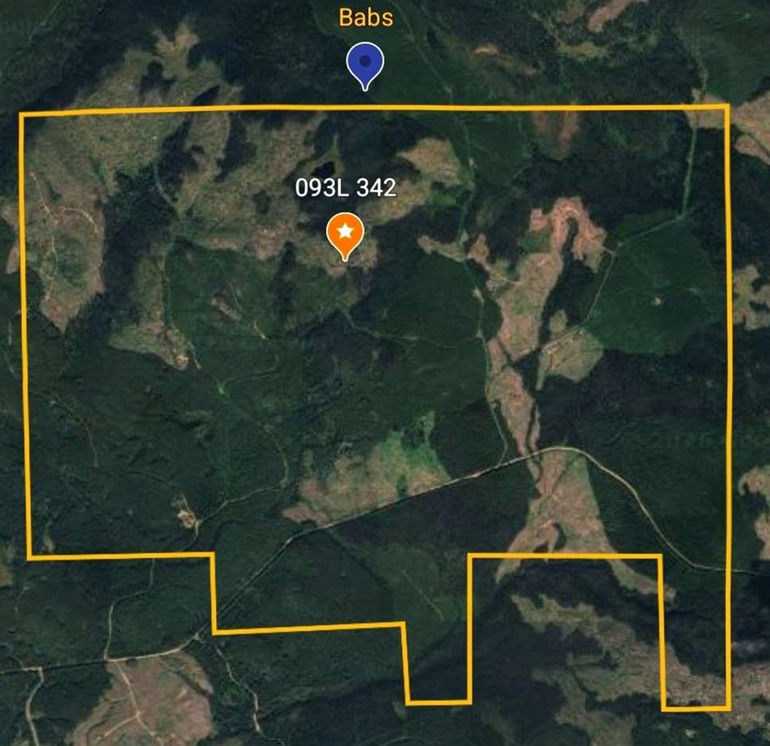
The property is associated with the Babs mineral occurrence (MINFILE 093L 342), which is classified as a porphyry copper ± molybdenum ± gold exploration environment. The documented commodities include gold and copper.
Historical High-Grade Sample Highlights
- Sample 45224: 5.0 g/t Au (ICP-ES)
- Sample 042456: 2.0 g/t Au (ICP-ES)
- These results were obtained from mineralized intrusive rock samples containing approximately 1–2% pyrite with traces of chalcopyrite (2012 grab samples).
Geological Programs
- Geological mapping
- Prospecting
- Rock sampling
- Geological interpretation
- Mineral occurrence evaluation
Geochemical Surveys
- Soil geochemical surveys
- Rock geochemistry
- Follow-up sampling
- These programs identified discrete geochemical anomalies requiring additional evaluation.
Geophysical Exploration
- Magnetic anomalies
- Intrusive bodies
- Potential sulphide-bearing zones
- These datasets provide a foundation for modern exploration targeting.
Prospecting & Sampling
In 2012, prospecting crews completed field investigations on the Babs claims, collecting samples from available bedrock exposures. Several samples were identified as altered intrusive rocks containing pyrite and chalcopyrite.
Geological Opportunity
- Intrusive rock units
- Hydrothermal alteration zones
- Copper sulphide occurrences
- Historical geochemical anomalies
- Exploration targets requiring additional evaluation
Exploration Potential
- Compilation of historical exploration data
- Updated geological interpretation
- Detailed geophysical surveys
- Soil and rock geochemistry
- Drill target development
- Diamond drilling programs
Investor Considerations
- A defined land position
- Existing technical history
- A clear acquisition structure
- Retained royalty participation
- Potential for value creation through exploration success
Regional Geology & Setting
The Babs Mineral Claim is located within a highly prospective porphyry copper district of central British Columbia and is situated approximately 9 km from the former Granisle Mine and 17 km from the Bell Mine. The claim area lies within the broader Babine Lake mining camp, where several significant copper-gold porphyry systems occur. The regional geology is characterized by Jurassic Hazelton Group volcanic rocks intruded by Eocene Babine Plutonic Suite porphyries, which are associated with copper, gold, silver, and molybdenum mineralization. The close proximity of the Babs Mineral Claim to these past-producing deposits suggests that it occupies a favourable geological setting influenced by the same intrusive, structural, and hydrothermal processes responsible for mineralization at the Granisle and Bell deposits.
Granisle Mine (Nearby Past Producer)
The Granisle Mine, located approximately 9 km from the Babs Mineral Claim on MacDonald Island in Babine Lake, is a past-producing porphyry copper-gold-silver-molybdenum deposit. The deposit is hosted by Jurassic Hazelton Group volcanic rocks intruded by Eocene Babine Plutonic Suite quartz diorite and biotite-feldspar porphyry bodies. Mineralization occurs as stockwork-style veining and disseminations, with chalcopyrite, bornite, pyrite, and molybdenite as the principal ore minerals. The deposit is associated with potassic, sericitic, and propylitic alteration zones, and mineralization is structurally controlled by northwest-trending faults and fractures. Mining operations from 1966 to 1982 produced significant quantities of copper, gold, silver, and molybdenum, confirming the economic potential of the Babine Lake porphyry district.
Bell Mine (Nearby Past Producer)
The Bell Mine, located approximately 17 km from the Babs Mineral Claim on Newman Peninsula at the north end of Babine Lake, is another major past-producing porphyry copper deposit. The Bell deposit is hosted primarily by Eocene Babine Plutonic Suite biotite-feldspar porphyry intrusions that cut Jurassic Hazelton Group volcanic rocks and Cretaceous Skeena Group sedimentary rocks. Copper mineralization occurs mainly as disseminated and fracture-controlled chalcopyrite with lesser bornite, associated with quartz stockwork veining and hydrothermal alteration. The deposit also contains gold, silver, zinc, lead, and molybdenum values. Production began in 1972, and the Bell Mine processed approximately 71 million tonnes of ore, making it one of the significant copper producers within the Babine Lake porphyry camp.
Property Location Map
Babs Property claim outline with MINFILE 093L 342 occurrence.
Regional Context Map
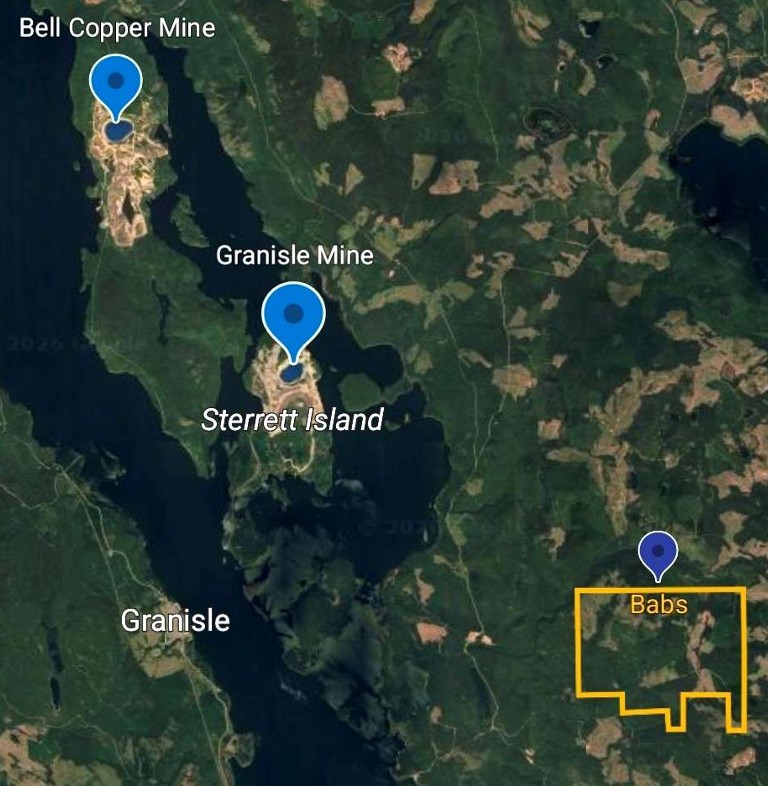
Babs Property relative to the Bell and Granisle mines, Babine Lake.
Datos clave
- PropertyBabs Property
- Area1,395.70 hectares
- LocationBritish Columbia, Canada
- MINFILE093L 342
- Purchase PriceCAD $120,000.00
- Royalty2% NSR (buyback of 1% for CAD $1,000,000.00)
- CommoditiesCu, Au, Ag, Mo